Do You Remember Your Grandmother’s Hands?
Or maybe it was your great-grandmother. Or an aunt who lived in the village. Someone from a generation before everything became fast. Back then, there was no such thing as an overstimulated child.
Think about her mornings.
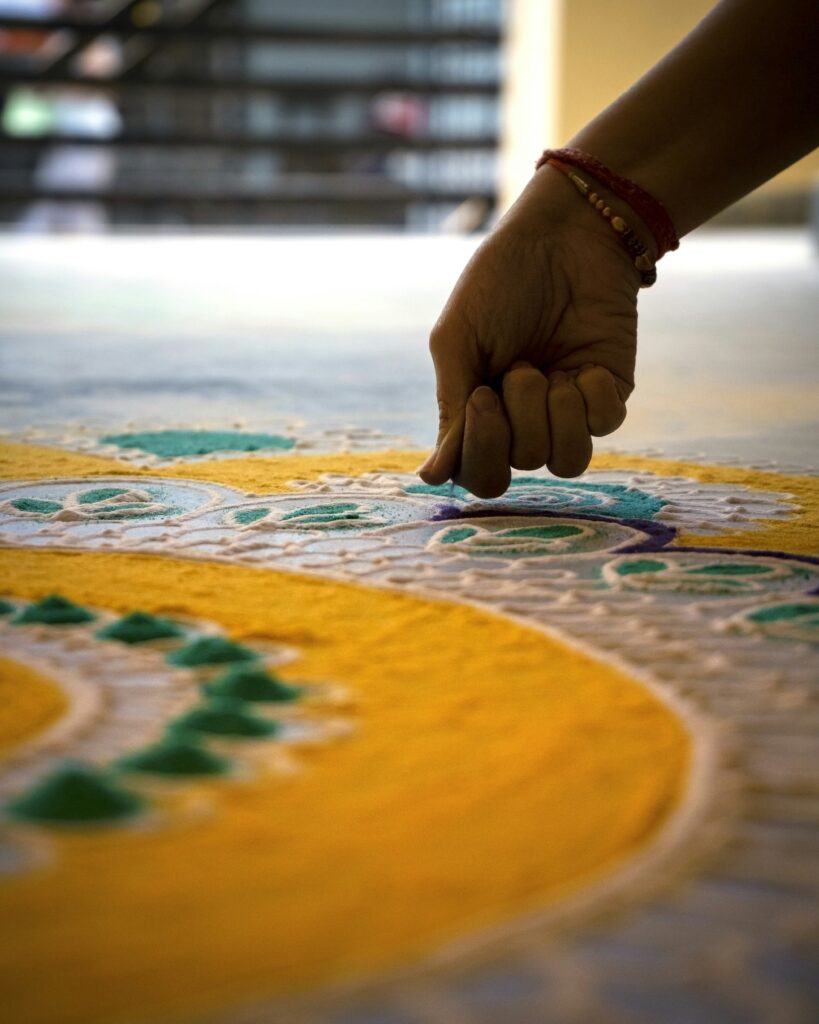
Maybe she woke before the sun, before anyone else was awake, and squatted outside the house drawing kolam with rice powder. Or maybe it was rangoli, or a simple pattern swept into the freshly washed floor.
Her fingers moved slowly. Deliberately. The same patterns she had drawn a thousand times before. Dots first, then the lines connecting them, looping, curving, closing.
She never rushed. Her breath was steady. Her body was still except for the hand.
By the time she finished, something in her had settled. You might not have had words for it then. Now maybe you do: she had regulated herself before the day even began.
Then perhaps she moved to the kitchen. The stone mortar and pestle. Grinding spices – cumin, coriander, mustard seeds cracking under pressure. The rhythm was always the same. Thud, scrape, turn. Thud, scrape, turn.
And while she ground, she would hum. Not a song exactly. Just a melody. Something her mother had probably hummed, and her mother before that.
Movement. Making. Rhythm.
All before 7 AM.
She didn’t know she was doing something important. She didn’t read a book about nervous system regulation or attend a workshop. She just did what her body knew to do, what her mother had done, what her grandmother had done.
And if you can remember her clearly, she was probably one of the calmest people you knew.
Now Think About Your Mornings
The alarm goes off. You reach for your phone. Notifications flood in.
You drag yourself out of bed, rush to get the children ready, shout about brushed teeth and packed bags, scroll through messages while half-listening to a complaint about breakfast, and somehow – somehow – get everyone out the door.
By 8 AM, your nervous system has already been hijacked. And your child’s has too.
No kolam. No grinding. No humming. No slow, rhythmic beginning that tells the body: you are safe, the day is starting gently, you can settle.
Just speed. Just noise. Just reaction.
And then we wonder why our children seem so dysregulated by evening. Why they melt down over small things. Why they can’t sit still. Why they’re either bouncing off the walls or collapsing into tears. Why they feel overstimulated?
We say: “They’re overstimulated. Too much screen time. Too many activities. Too much input.”
And yes – maybe.
But I want to offer you a different question.
What If They’re Under-Resourced, Not Overstimulated?
When I was training in Expressive Movement Therapy, I came across the work of Dr. Bruce Perry, a psychiatrist who has spent decades studying how children’s brains develop.
One of his central findings is this: the brain, especially in the early years, develops through patterned, repetitive, rhythmic experiences. Rocking. Swinging. Drumming. Walking. Humming.
These aren’t just pleasant activities – they are how the lower brain organises itself, how it learns to regulate arousal, how it builds the foundation for everything else: attention, learning, emotional control (Perry, 2006).
Dr. Stephen Porges, the neuroscientist who developed Polyvagal Theory, adds another layer. He shows that the nervous system doesn’t just regulate itself – it regulates through connection. Through safe eye contact. Through warm vocal tones. Through the presence of another person whose nervous system is calm (Porges, 2011).
This is called co-regulation, and it’s the original way human beings learned to settle themselves: not alone, but together.
Then there’s Dr. Bessel van der Kolk, whose research on stress and the body shows that we cannot think our way into calm. The body needs to move to discharge activation. Sitting still and “calming down” doesn’t work – the energy has nowhere to go (van der Kolk, 2014).
And finally, Cathy Malchiodi, one of the pioneers of expressive arts therapy, has shown that making things with our hands – drawing, moulding, building, creating – activates parts of the brain that verbal processing doesn’t reach (Malchiodi, 2020).
When a child makes something, they’re not just being creative. They’re processing, organising, regulating.
The Four Resources Every Child’s Nervous System Needs
So what does this research tell us?
Movement. Making. Rhythm. Connection.
These are the four resources the human nervous system needs to regulate itself.
And here’s what I keep coming back to:
Our grandmothers had all four. Built into daily life. Without thinking about it.
Think about what a day used to look like – not even that long ago, maybe just two or three generations back.
You woke up, and your body moved. You walked to fetch water. You squatted to sweep the floor. You climbed, bent, carried, lifted. Before you even “exercised,” your body had already moved in a dozen different ways.
You made things with your hands. You rolled rotis. You drew kolam. You stitched clothes. You pounded grain. You shaped, you moulded, you created – not as a hobby, but as life.
You heard rhythm everywhere. The mortar and pestle. The lullaby at naptime. The folk song while working. The drum at the festival. Pattern and repetition, woven into the hours.
And you were never alone. The joint family. The neighbours who walked in unannounced. The grandmother sitting in the corner. The aunts, uncles, cousins – all present, all regulating each other without knowing they were doing it.

What We’ve Removed From Your Overstimulated Child’s Life
Now imagine what we’ve taken away.
Movement has become something we schedule – a sport class, a PE period – not something the body does naturally throughout the day. Our children sit in cars, sit in classrooms, sit at tables, sit in front of screens.
Their bodies are still for hours at a time, and then we’re surprised when they can’t settle at night.
Making has become optional – an “art activity” if there’s time, a craft project on the weekend. Most things are bought ready-made.
When did your child last knead dough, shape clay, create something with their hands that wasn’t a school assignment?
Rhythm has all but disappeared. How many families still sing together? How many children hear lullabies, real ones, sung by a human voice rather than played through a speaker?
The soundscape of most homes is either chaotic – television, notifications, overlapping voices – or silent. Neither offers the patterned, predictable rhythm the nervous system craves.
Connection – real, present, regulated connection – has become the scarcest resource of all.
We are in the room with our children, but our eyes are on our phones. We live in nuclear units, isolated from the wider web of family and community that once held everyone.
Our children have fewer adults in their lives, fewer models of calm, fewer opportunities to co-regulate with someone whose nervous system can hold theirs.
We didn’t remove one resource. We removed all four. We dismantled the entire ecosystem that human beings evolved within. And then we labelled our children “overstimulated.”
The Difference Between Stimulation and Resource
Here’s what I want you to sit with:
Stimulation is not the same as resource.
Yes, there is more stimulation now than ever before. More screens, more noise, more input, more everything. I’m not disputing that.
But stimulation is what comes at your child. Resource is what your child has within them – or access to – in order to process that stimulation.
A child who has moved their body, made something with their hands, heard rhythm, and felt connected to a calm adult – that child can handle quite a lot of stimulation.
Their nervous system has the capacity to take things in, process them, and return to baseline.
However, a child who has been sitting still, consuming content, with no rhythm and no connection – that child will fall apart at the smallest trigger.
Not because they’re weak. Not because they’re “too sensitive.” But because they have no resources to regulate with.
The problem isn’t just what we’re adding. The problem is what we’ve taken away.
Are You Providing Enough of the Right Resources?
So here is the question I want to leave you with today.
Not: “How do I reduce stimulation?”
But: “Am I providing enough of the right resources?”
Not more toys. Not more classes. Not more enrichment activities that require sitting still and following instructions.
But:
Is there enough movement in your child’s day – real, unstructured, whole-body movement? Climbing, running, jumping, rolling, wrestling, dancing – not exercise as discipline, but movement as play?
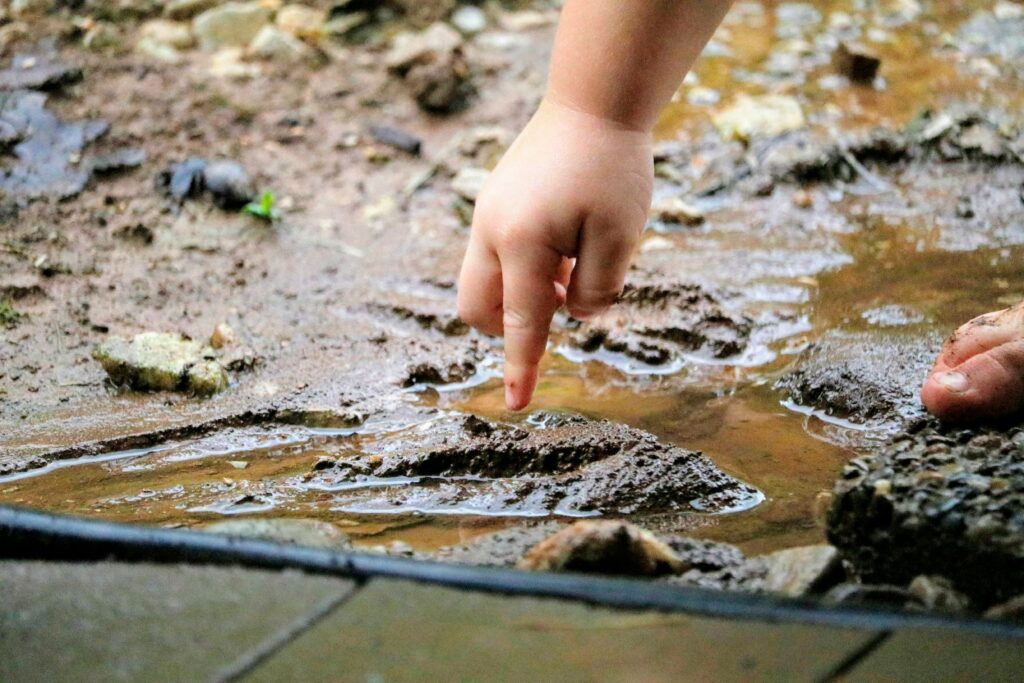
Is there enough making – hands in dough, fingers in mud, chalk on pavement, paint on paper? Are they creating, not just consuming?
Is there enough rhythm – songs, patterns, repetition, predictability? A lullaby at bedtime, a rhyme in the car, a hummed tune while you cook together?
Is there enough of you – your calm presence, your eyes, your voice, your steady nervous system offering their nervous system something to sync to?
Your Child Isn’t Broken – The Lifestyle Is
I’m not asking you to go back to grinding spices by hand. I’m not romanticising a past that was also hard in its own ways.
But I am asking you to notice what’s been lost.
And to consider that maybe – just maybe – your child isn’t broken. They aren’t “too much.” They don’t need to be fixed or medicated or trained into stillness.
Maybe they just need what every human being has always needed.
A body that moves. Hands that make. Ears that hear pattern. And another person – you – who is present enough to help them find their way back to calm.
And Before I Close – A Word for You
Everything I’ve said about your child? It applies to you too.
When did you last move without purpose – not exercise, not rushing, but just… moving your body because it felt good?
When did you last make something with your hands – cook something slow, draw something pointless, build something with no deadline?
When did you last hear rhythm – not background music, but something your body could actually sync to?
When did you last feel truly held by someone else’s calm?
If you’re depleted, if you’re snapping, if you’re running on fumes and wondering why you can’t stay patient – it’s not because you’re failing.
It’s because you’re under-resourced too.
We’ve removed the ecosystem for adults as much as for children. And you cannot pour from an empty vessel.
So as we go through this series together, I want you to hold both: what your child needs, and what you need. They’re not so different.
The nervous system is the nervous system. It doesn’t care how old you are. It needs what it needs.

Next Week: Why the Body Must Move to Think
Next Friday, we go deeper into the first resource: Movement.
Why the body must move to think. What we’ve replaced real movement with. And simple ways to bring it back – for your child and for yourself.
If this landed, here are two ways to stay connected:
Click to join our WhatsApp Community
A space for parents who want to go deeper – book readings, reflections, audio practices, and conversations that don’t happen elsewhere.
Explore our Workshops
If you want practical tools, not just understanding, our workshops give you things to try tonight.
~Preeti
References:
Malchiodi, C. A. (2020). Trauma and Expressive Arts Therapy: Brain, Body, and Imagination in the Healing Process. Guilford Press.
Perry, B. D. (2006). The Boy Who Was Raised as a Dog: And Other Stories from a Child Psychiatrist’s Notebook. Basic Books.
Porges, S. W. (2011). The Polyvagal Theory: Neurophysiological Foundations of Emotions, Attachment, Communication, and Self-Regulation. W. W. Norton & Company.
van der Kolk, B. (2014). The Body Keeps the Score: Brain, Mind, and Body in the Healing of Trauma. Viking.