I still remember the day at the beach when my daughter Aarya decided she wanted a mud bath.
She was maybe seven or eight. We were there with a friend, and Aarya found this patch of wet sand near the shore ,not the pretty golden kind, the dark sticky kind that squishes between your fingers. Within minutes, she was covered in it. Arms, legs, face. Completely lost in the sensation.
My friend turned to me and said, “Why do you let her do this? Who’s going to clean this mess? It’s so dirty.”
I just smiled. Because I knew something she didn’t see.
That “mess” was doing more for my daughter’s nervous system than any after-school activity ever could. The sensory experience. Freedom. The joy of being allowed to just… be. No rules about staying clean. No instructions about what to build. Just her, the mud, and whatever her imagination wanted to create.
This is what stress release activities for kids actually look like. Not a worksheet. Not a structured program. Not even a formal “mindfulness session.” Just a child, fully absorbed in play, with an adult who trusts them enough to let the mess happen.
Why We Need to Talk About Stress in Children
Here’s what most parents don’t realize: children carry stress differently than we do.
They don’t come home saying “I had a hard day at school” or “I’m feeling anxious about exams.” Instead, it shows up sideways. A child who can’t sit still. A child who snaps at their sibling for no reason. A child who suddenly doesn’t want to go to a birthday party they were excited about.
The academic pressure starts earlier than ever now. Screen time has become the default babysitter. Social expectations pile up before children even understand what “fitting in” means. And all of this accumulates in their small bodies ,because stress lives in the body first, before the mind even has words for it.
That’s why stress release activities for kids aren’t optional anymore. They’re essential. But here’s the thing ,they don’t have to be complicated.Research confirms what many parents intuitively sense: children who participated in regular outdoor activities showed significant reductions in cortisol levels ,the hormone our bodies produce under stress. Play doesn’t just feel good. It’s doing something real at a biological level.
Why We Need to Talk About Stress in Children
Let me tell you about something that still bothers me.
I was at an art class once ,not Aarya’s, but I was observing another child. He was maybe six years old, painting happily. His tree was blue. His river was red. He was completely absorbed, creating something that made sense to him.
The art teacher walked over and corrected him. Made him start over. “Trees aren’t blue. Rivers aren’t red. Do it properly this time.”
I watched his face change. Something closed. The painting he made after that was “correct” ,green tree, blue water. And completely lifeless.
This is what happens when adults interrupt the creative process. When we prioritize “right” over exploration. When we can’t tolerate the mess of real learning.
And then ,this is the irony ,when these same children grow up, we expect them to “think outside the box.” To be creative problem-solvers. To innovate.
How? We trained the creativity out of them at six years old.
Outdoor Play: The Original Stress Release
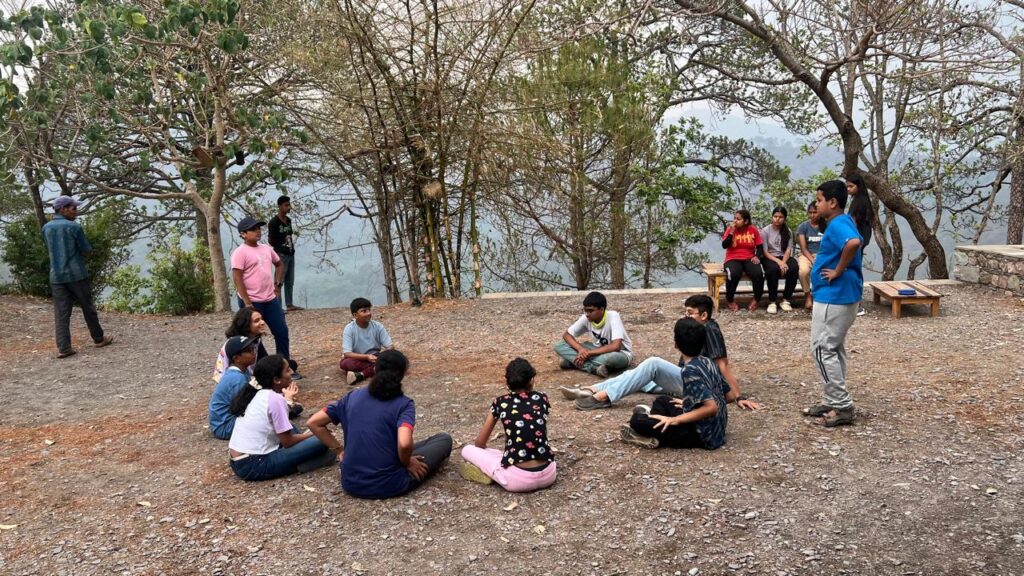
Dr. Gabor Maté, the physician and child development expert, talks about four irreducible needs of children: attachment, rest, emotional validation, and free spontaneous play. Not structured play. Not educational play. Free play ,where nothing is required, there’s no winning or losing, no purpose except the experience itself.
He’s clear that play is more important for brain development than academic information.
And Donald Winnicott, the British pediatrician and psychoanalyst, put it even more directly: “It is in playing and only in playing that the individual child or adult is able to be creative and to use the whole personality, and it is only in being creative that the individual discovers the self.”
Not learns facts. Discovers the self.
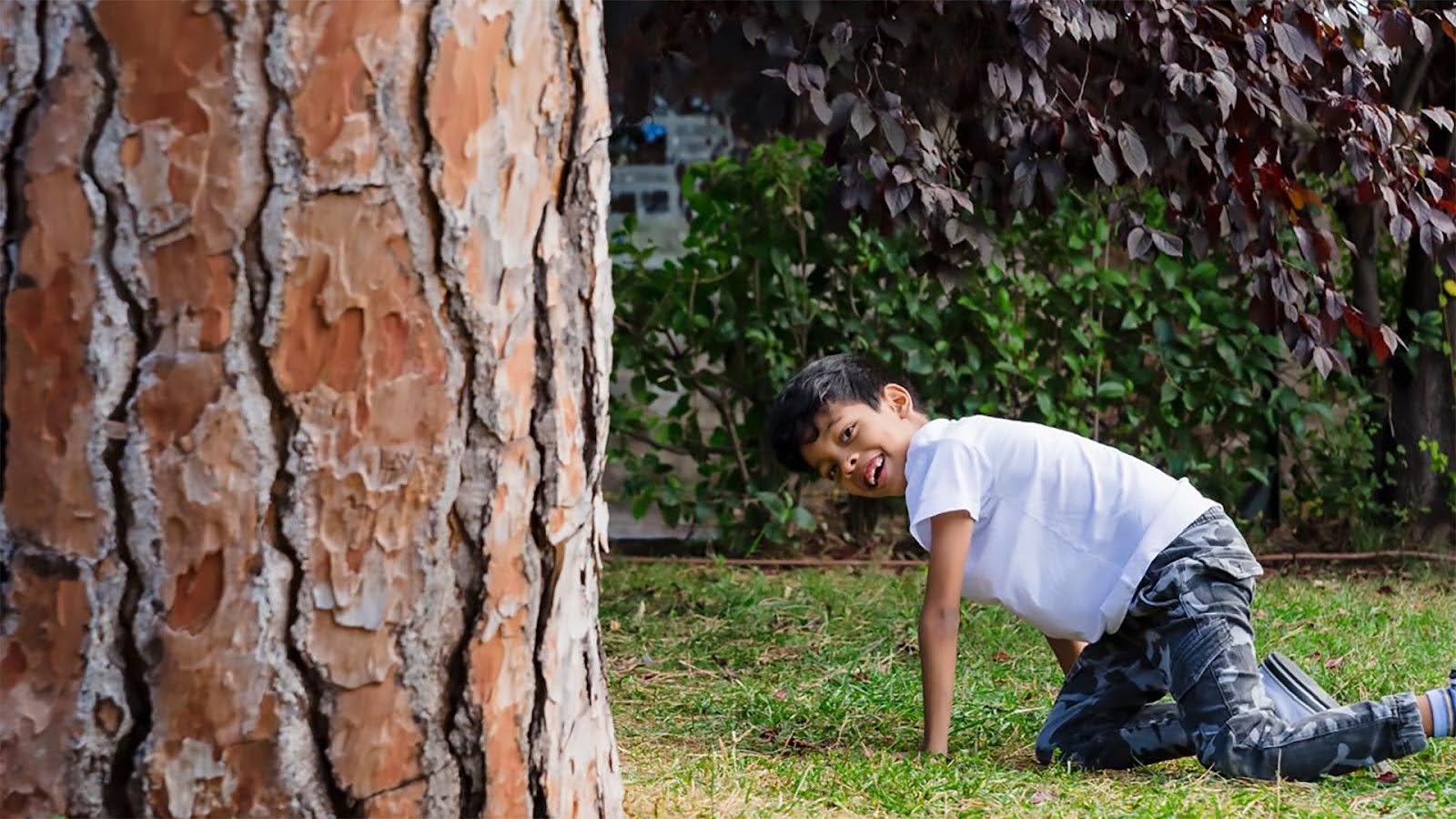
Outdoor play is one of the most powerful stress release activities for kids because it does so many things at once. Children move their bodies, which releases built-up tension. They breathe fresh air. They encounter unpredictable textures, sounds, smells. They negotiate with other children ,learning to share, to wait, to resolve conflict without an adult stepping in.
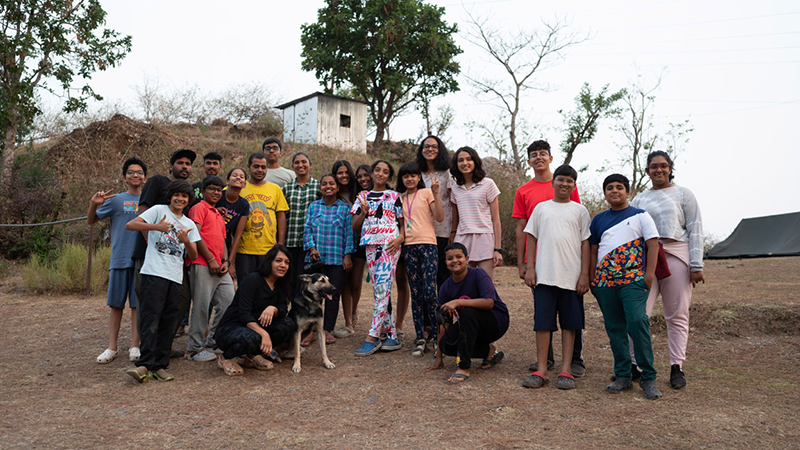
When my daughter was small, I created as many opportunities as I could for unstructured play. Mud during the monsoons. Beach sand. Water play. Dough and drapes and wooden blocks and beeswax. Sometimes water colors that ended up on the walls as much as the paper.
Was it messy? Yes. Always.
Was it inconvenient? Sometimes, yes.
But I watched her grow into someone emotionally healthy. Resilient. Empathic. Creative in her problem-solving. These aren’t skills I taught her from a book. They developed through thousands of hours of free play ,the kind where I stepped back and let her figure things out.
She’s fourteen now, and those foundational capacities haven’t gone anywhere. Technology skills come and go. What she learned through unstructured play will stay with her forever.
What Actually Happens When Children Play Freely
When outdoor play is truly free ,no adult directing, no “right way” to do it ,something remarkable happens.
Children become problem-solvers. Not because someone teaches them “problem-solving skills,” but because play naturally presents problems. How do I balance on this log? How do I get my friend to share the stick? How do I build something that doesn’t fall over? They figure it out. Or they don’t, and they try something different.
They develop social skills organically. I’ve watched children negotiate, compromise, get angry, make up ,all without adult intervention. They learn that conflict doesn’t end relationships. They learn to move on.
Their senses come alive. Touch, smell, sound, movement. The brain develops through sensory experience. This isn’t theory ,research shows that play activates reward circuits in the brain without triggering stress responses, creating ideal conditions for learning.
And here’s something that might surprise you: studies show that the timing and amount of outdoor play directly impacts children’s ability to regulate their emotions. It’s not just that they feel better in the moment ,they’re building the actual capacity for emotional regulation.
The Inconvenience Problem
I want to name something honestly.
One of the biggest barriers to outdoor play isn’t lack of parks or unsafe neighborhoods. It’s that unstructured play is inconvenient for adults.
“Who will clean this mess?” That question my friend asked at the beach ,I’ve heard versions of it many times. From family members, from other parents, from well-meaning people who just… don’t see what’s happening underneath the dirt.
Sometimes the resistance comes from our own conditioning. Some of us grew up in homes where mess wasn’t tolerated. Where play happened within strict boundaries. Where we learned that staying clean was more important than exploring freely. We carry that into our parenting, even when we don’t mean to.
I’m not saying every moment should be a mud bath. Boundaries matter. But if the only reason we’re stopping a child from playing is because cleanup is annoying ,that’s worth examining.
The mess washes off. The experience stays.
Nature Walks: A Different Kind of Stress Release
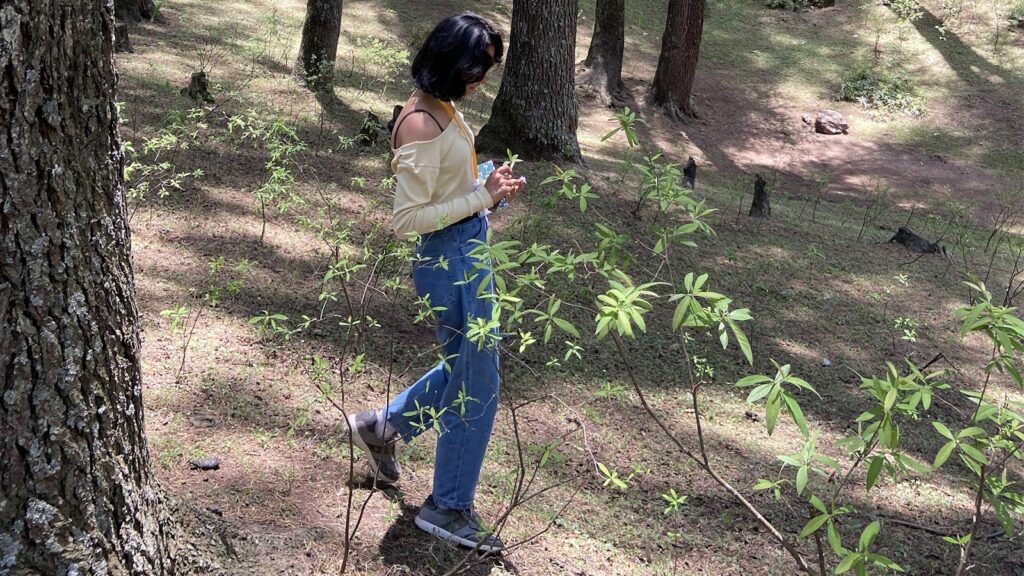
Not all stress release activities for kids involve wild physical play. Sometimes what a child needs is to slow down.
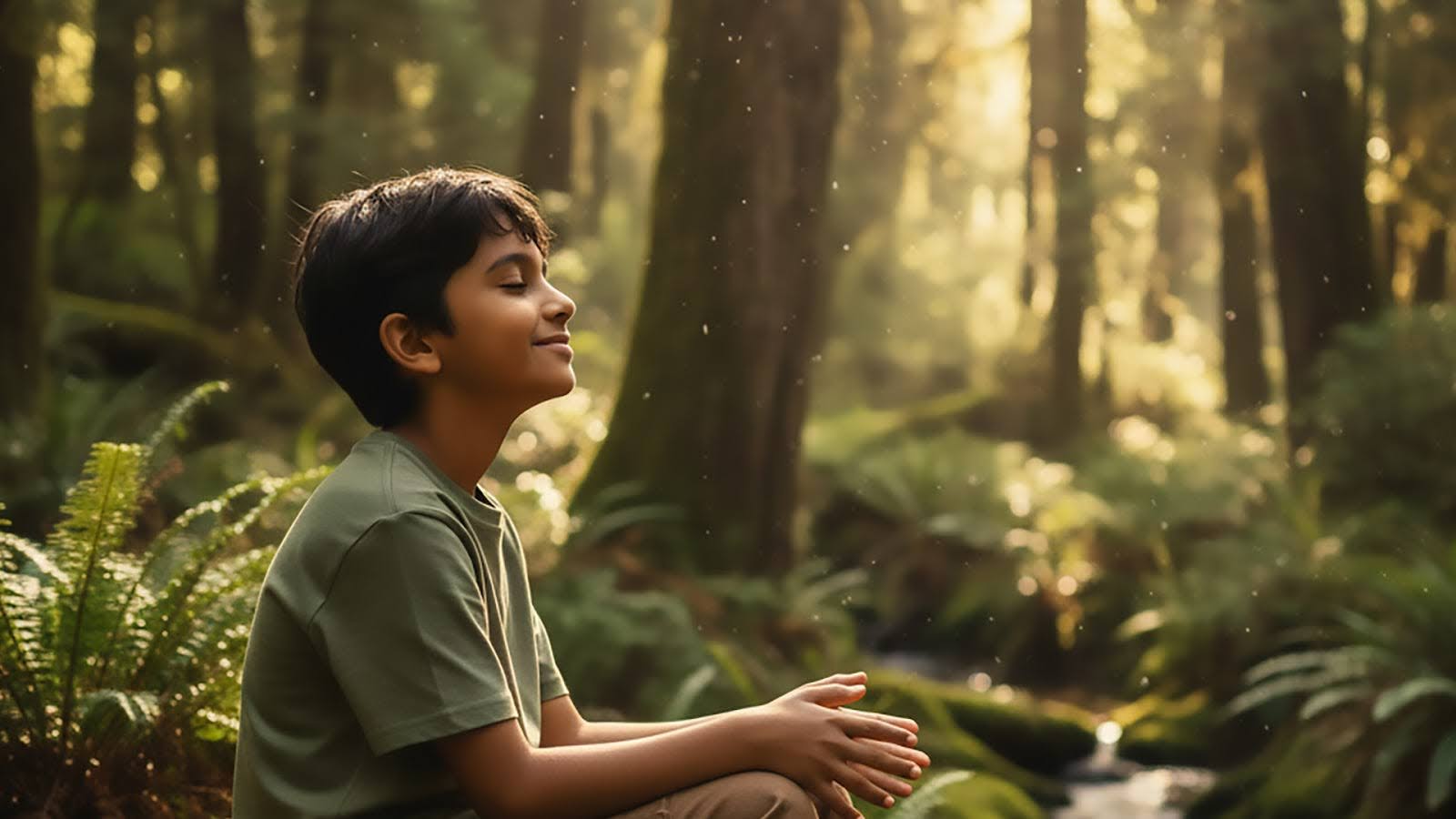
Nature walks work differently than outdoor play. They’re quieter. More internal. A child walking through a forest or along a trail begins to notice things: the sound of leaves, the patterns on stones, a bird moving through branches.
This is mindful without anyone calling it mindfulness. The natural world invites attention without demanding it.
Research on forest environments shows significant reductions in cortisol after spending time in natural settings. The nervous system calms. The breath deepens. The constant background noise of modern life ,screens, traffic, notifications ,falls away for a little while.
At Young SoulTales, when we take children on nature walks, we don’t make it about education. We don’t quiz them on bird species or tree names. We just walk. Slowly. Stopping whenever something catches their attention.
The destination doesn’t matter. What matters is being present on the path.
Mindfulness That Actually Works for Kids
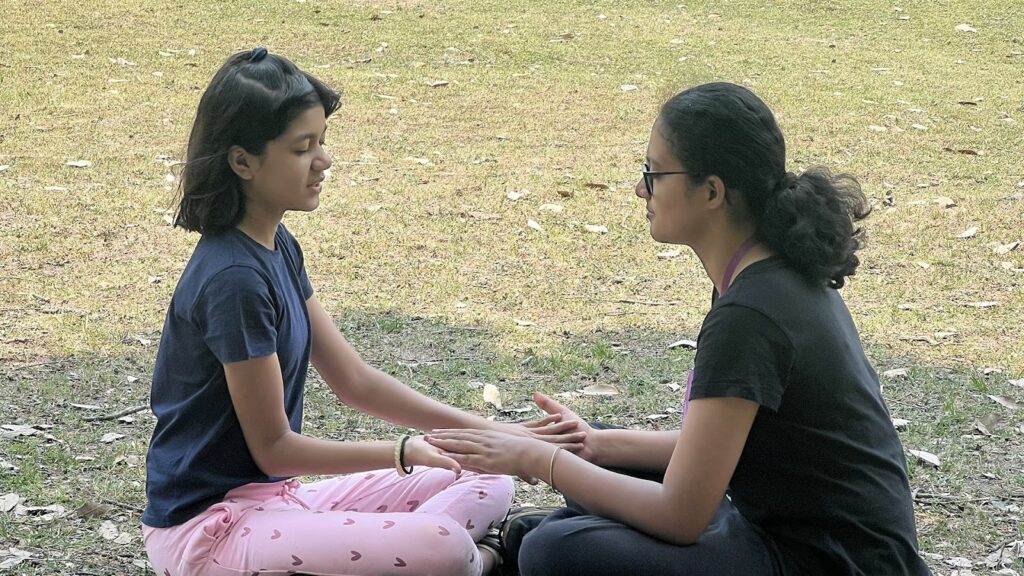
Here’s what doesn’t work: sitting a restless eight-year-old down and telling them to “focus on their breath” for ten minutes.
Here’s what does work: giving that same child a pinecone and asking them to notice everything about it. The texture, the weight, the smell, how it feels different when you close your eyes.
Mindfulness for children has to be experiential. Playful. Pressure-free.
Simple mindfulness activities for kids might look like:
Listening games outdoors ,how many different sounds can you count? Breathing with the rhythm of waves, or with the rise and fall of their own belly. Finding five things of the same color in nature. Lying on the grass and watching clouds change shape.
These stress release activities for kids help them understand their feelings rather than suppress them. Over time, children who practice this kind of attention develop emotional intelligence, empathy, and self-trust ,not because someone taught them about feelings, but because they learned to notice their own.
At Young SoulTales, mentors walk beside children, not ahead of them. We create space where mindfulness feels natural, not like another thing to get right.
Why Experience Matters More Than Instruction
There’s a reason experiential learning works for stress release in ways that instruction doesn’t.
You can tell a child “take deep breaths when you’re upset.” They might remember it. They probably won’t do it in the moment when they’re actually upset.
But if that child has spent hours in nature, has felt their body calm down outdoors, has experienced what it’s like to go from frustrated to peaceful through movement and play ,they carry that in their body. The body remembers. When stress rises, something in them knows there’s another way to feel.
This is what I’m studying in my training as an Expressive Movement Therapist. The body experiences first. It stores memory. Creating experiences that engage all the senses isn’t just nice ,it’s how real change happens.
When children step away from routine environments and have real experiences ,in nature, in movement, in play ,they discover things about themselves no classroom could teach them.
What Young SoulTales Offers
At Young SoulTales, we believe every child carries their own rhythm of becoming.
Growth unfolds best when it’s witnessed, not forced. Not rushed. Not corrected into someone else’s idea of “right.”
Our programs for ages 6 to 17 blend outdoor play, nature walks, and mindfulness ,but not in a way that feels like curriculum. We create conditions where children can explore freely, supported by mentors who know how to hold space without directing.
Away from familiar routines, children begin to notice:
What calms them. What excites them. What they’re capable of when no one’s watching. The quiet strength that was always there, waiting for permission to emerge.
Winter & Summer Retreats for Kids blend outdoor exploration, nature immersion, and mindful experiences in a nurturing environment where children can simply be themselves.Youth Retreats support older children and teens in building emotional regulation, self-awareness, and resilience through real experiences ,not lectures about these qualities, but opportunities to live them.
A Note to Parents
If you’ve read this far, you probably already sense that your child needs more unstructured time. More nature. More freedom to play without constant supervision and correction.
You might also feel the pull of all the other pressures ,academics, activities, the fear that your child will “fall behind” if they’re not constantly learning something structured.
I understand. I’ve felt it too.
But here’s what I’ve come to believe, both as a mother and as someone training in this work: the most important things children learn don’t come from instruction. They come from experience. From being trusted. From having adults in their lives who can tolerate the mess, hold the space, and resist the urge to turn every moment into a teaching opportunity.
Stress release activities for kids aren’t about adding another item to an already crowded schedule. They’re about making room. For play that has no purpose except joy. For walks that go nowhere in particular. For afternoons where getting dirty is allowed.
The stress doesn’t need to be “fixed.” Given the right conditions ,presence, nature, play, freedom ,it naturally melts. And in its place, something else grows.
Calm. Confidence. A child who knows themselves a little better.
That’s worth a mess.
Frequently Asked Questions
How does outdoor play help children reduce stress?
It works on several levels at once. Their bodies move, which shakes off tension they’ve been holding. Sunlight and fresh air shift their mood. And there’s something about being outside ,studies show cortisol actually drops faster outdoors than in.
But I think the deeper thing is freedom. So much of a child’s day is controlled by adults. Outdoor play ,real unstructured play ,gives them back a sense of agency. They choose what to do. That alone is stress-relieving.
Why are nature walks effective for managing stress in children?
There’s a quality of attention that nature invites. Researchers call it “soft fascination” ,you’re engaged, but it’s not effortful the way screens or schoolwork demand.
When a child walks through a forest or along a trail, their mind slows down to match the pace. They start noticing ,leaves, sounds, the way light falls.Research confirms stress hormones drop significantly in natural settings. Nature walks work because they’re gentle. No one’s asking anything of the child except to be present.
Can mindfulness really help kids deal with stress?
It can. But not the way most people imagine.
Telling a seven-year-old to “sit still and breathe” usually backfires. What works is mindfulness through the back door, sensory games, noticing challenges, breathing that’s tied to movement or play.
When kids learn to notice what they’re feeling, without anyone making a big deal about it, they build emotional regulation over time. Not overnight. But gradually, they develop resilience. They learn that big feelings come and go.
At what age should children start stress release activities?
As soon as they’re experiencing stress. So, realistically? Five or six, when school pressures begin.
But here’s the thing, stress release activities for a six-year-old should look like play. Not therapy. Not a formal practice. Just outdoor play, nature walks, creative messing around. Keep it light. Keep it fun. The benefits happen whether or not the child knows they’re “working on stress.”
How do experiential programs help children manage stress?
There’s something powerful about getting out of your normal environment. Routine can be comforting, but it can also keep stress patterns locked in place.
Experiential learning programs take children somewhere new, physically and emotionally. They face small challenges. They discover they can handle things they weren’t sure about. That builds resilience in a way no lecture ever could.
The body learns through experience. Not through being told.
How does Young SoulTales support stress-free growth in children?
We don’t try to “fix” children or make them less stressed through instruction. We create conditions, outdoor play, nature, movement, community, where stress naturally releases and something quieter emerges.
Our mentors don’t stand at the front of a room. They walk beside children. Noticing. Holding space. Not pushing.
Young SoulTales programs are designed around a simple belief: growth unfolds best when kids feel safe enough to explore without pressure to perform or change. We trust the process. And we trust children.
Are camps helpful for children dealing with stress?
The right kind of camp? Absolutely.
Not the kind where every minute is scheduled and kids are competing for awards. But immersive experiences like our Winter & Summer Retreats for Kids, where there’s time in nature, room to breathe and explore.
Kids come back different. Not because we changed them. Because they had space to discover what was already there.